
Funding Transformative Momentum in Research for Development Systems: the TR4D Framework
It is widely recognised that research for development (R4D) has contributed to important development gains, despite decades of investment and innovation, struggles to meet its potential to address today’s complex societal challenges. The current funding crisis highlights the urgency of the challenge.
Long-standing problems remain unresolved even as new threats rapidly intensify. Key challenges include frequently weak lines of sight between investment, development processes, and outcomes; institutional and funding structures that undermine diversity, dampen creativity, and reproduce bias; exclusions and inequalities in research access, agency, and uptake; and poor coherence and connectivity, which inhibit systemic change.
There is increasing urgency to identify inclusive and collaborative ways to respond. There are promising trends, bright spots and bold new initiatives, but progress remains fragmented, and many structural issues continue to go unaddressed.
International research for development funders are grappling with ways to more effectively improve systems, not just projects, and political and research leaders are increasingly united in calling for stronger research systems in low and middle-income countries. Despite the challenging global funding situation right now, and arguably spurred on by it, there is an important window of opportunity.
Efforts to dismantle North-South binaries and promote equitable partnerships are not new. From the KFPE principles to recent frameworks such as the Africa Charter, the Cape Town Statement, UKCDR’s guidance, the Science Granting Councils Initiative and Southern Voice/IDS reports – there has been a surge in ideas and action. These efforts represent just a few of the many brilliant ideas, partnerships, and innovations that are already challenging the status quo.
But what is urgently needed is a way to locate, connect, and scale these diverse efforts within the broader R4D ecosystem—so they add up to more than the sum of their parts. This requires ways of recognising the transformative potential of the current research ecosystem in particular contexts, to learn from existing change initiatives, and to prioritise research funding and other associated investments in the enabling conditions for them to thrive.
This is where the TR4D (Transformative Research for Development) framework comes in.
A Framework to Support Transformative Conversations
The framework is grounded in current practice and debate – an illustrative snapshot of current momentum. It seeks to help structure dialogue about the research ecosystem and its structural challenges, on what sort of transformation is sought and by whom, and what is working right now, supporting bigger conversations about systems change.
The framework was developed with the premise that a transformative R4D system for the future starts not by reflecting on an idealised end-state. It starts by understanding the nature of entrenched challenges, the change processes that are already underway to address them, and how they can be recognised and supported.
It is this understanding of the present that provides a launch pad to identifying effective ways to support those ongoing processes of change and identify gaps. It provides a baseline to consider how existing initiatives could be contributing in a more joined-up way to system change. This helps us anchor strategy and investment planning in the real opportunities of today.
For example, a framework of this kind could open up much richer conversations about how research funding actually flows—how current mechanisms either enable progress or, through entrenched inequalities, quietly reproduce the very barriers that prevent genuinely transformative research systems from emerging. Transformative R4D systems are those that not only deliver societal impact but are also able to be responsive and adaptive in meeting diverse local and national sustainable‑development priorities. By identifying where local capacities already exist, valuing experimentation, and highlighting places where synergies and system‑level shifts are beginning to take hold, the framework could help direct attention toward meaningful levers for change. In doing so, it would echo Francesco Obino’s call in the GlobalDev series to “continually confront what has shifted and what remains unchanged,” encouraging a more honest and adaptive approach to strengthening research ecosystems.
Thus, the TR4D framework seeks to help synthesise stakeholder insights in a way that is both intuitive and evidence-based. It does not present a vision or prescribe paths forward, but offers a shared language and structure for collaboration, joined-up thinking and collective action across the R4D system.
How the Framework Took Shape
This framework grew out of reflections on decades of collaborative learning across long-term, problem-focused research initiatives, science, technology and innovation systems work at the Science Policy Research Unit (SPRU) and reviews of published articles, debates and workshop proceedings. With its emphasis on current change initiatives, the framework also draws on previous work with national R4D teams and global transdisciplinary action research networks.
It evolved into its current form as a foresight framing input to the ‘Disrupters and Enablers of R4D: Exploring Futures' project, funded by the International Development Research Council (IDRC) and led by Tanja Hichert and Rika Preiser, UNESCO Chairs at Stellenbosch University’s Centre for Sustainability Transitions. This is where organising principles for the framework were tested and refined through an intensive, collaborative process.
The database of R4D ‘issues’ and change processes that populate it was further developed from collective intelligence sessions, debates, desk reviews, and local and regional stakeholder consultations. Contributors shared what excites them, what concerns them, and where they see change happening.
Looking Inside the Framework Diagram
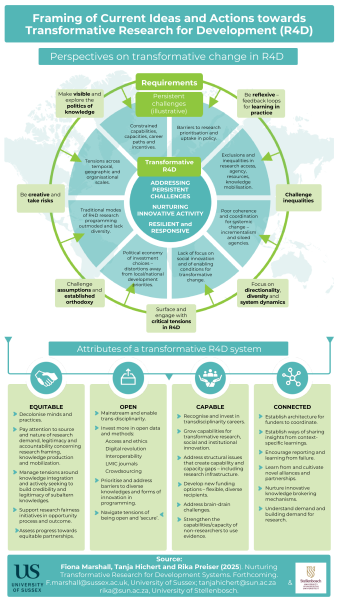
At its core, the framework presents a layered view to support dialogue on what drives or constrains R4D transformation in particular contexts.
The inner circle sets out system-level goals. Here, the proposition is that a transformative R4D system is one that
● Addresses persistent challenges
● Nurtures innovation activity
● Is responsive and resilient in an uncertain world
The second circle surfaces persistent challenges and identifies what needs to change.
Though these systemic issues are deeply entrenched and context-dependent, many are widely recognised.
This part of the framework is designed to help add to and amend them, surface and name them—opening space for honest reflection and shared strategy.
The outer circle moves from diagnosis to problem-solving. It highlights examples of ways of thinking or doing that will tackle the persistent challenges. Drawing insights from grounded initiatives, these requirements include reflexivity, challenging orthodoxies and inequalities, paying attention to tensions (e.g. between excellence and equity or priorities of funders and national or local stakeholders), and providing space for experimentation – things that can be at odds with current funding and institutional norms.
One key set of ideas here is attention to the politics of knowledge, captured through the ‘3Ds’ (Leach et al., 2012)
● Directionality: Consider who sets the R4D agenda, what assumptions are involved, what alternatives are excluded and why?
● Diversity: Are multiple voices and knowledge systems being meaningfully included?
● Distribution: Who benefits from R4D—and who bears the risks or burdens?
This combination of grounded examples and organising ideas helps to surface where the power lies in research systems—and draw attention to processes of current and potential transformative change.
The propositions and examples in the framework visualisation are just a starting point for discussion. At a workshop in Stellenbosch, for example, participants proposed adding care, humility, and trust as guiding values. These could also be placed at the heart of the diagram alongside the system goals, or as values to be fostered as core requirements for enabling change.
Four Attributes of a Transformative R4D System
The lower part of the framework focuses attention more closely on current and proposed change initiatives
Working from examples of grounded activities and associated debates, a cluster of four system-level attributes emerged – the proposition is that these attributes are essential components of an enabling research ecosystem which progresses towards the transformative R4D goals.
● Equitable: inclusive in research access and process, surfacing power dynamics
● Open: ensuring diverse knowledges, local embeddedness, transparency, collaboration
● Capable: addressing research capability and capacity gaps, including infrastructure
● Connected: integrated across actors, scales, sectors, and systems
The bullet points listed under each attribute are just examples of priority actions for working towards one or more of the goals of a transformative research system - drawn from the broad synthesis of current R4D debates and initiatives. Most initiatives that are aimed at tackling specific entrenched challenges are also contributing to the resilience of the system, and to nurturing other innovative activity, through building the system attributes.
The attributes are both individually necessary and mutually reinforcing. They are mutually reinforcing because a change initiative that helps build any one of these four system attributes also depends on all four attributes to thrive.
For example, initiatives designed to challenge inequalities and at the frontier of promoting equitable partnerships will require open data and methods, capacity building to foster forms of trans-disciplinarity, and connectivity across research funders and other key stakeholders to learn from success and failure. A capable and connected system, in other words, is better placed to be open and equitable.
Thus, the system attributes themselves are interdependent and co-evolve. The four attributes are being built by the change initiatives, which themselves depend upon the four attributes to thrive.
At a policy and practice level, this suggests that once grounded in a particular context, a focus on the system attributes and the barriers and opportunities for nurturing them can provide a useful entry point for thinking about how to foster enabling research ecosystems which meet desired transformative goals. For research funders
What’s Next?
The TR4D framework is intended as an evolving resource—something that can be challenged, adapted and used to support reflection, learning, and strategic action across different settings. It helps to locate emerging transformation in a broader conversation about the research ecosystem, system change and leverage points. Whether you’re designing a new initiative, evaluating an existing one, or exploring ways to understand and shift the system, you are invited to use and adapt the framework in whatever ways it is most useful.
For example, the attributes of an open, equitable, capable and connected system (with potential for additional attributes in given contexts) could work as a diagnostic entry point for strategic planning at an organisational, programmatic or national level, and for prioritising future research funding investments
With such an approach, initial questions would include:
● How are our existing initiatives contributing to and benefiting from the four system attributes? Where are we stronger or weaker and why?
● How is this impacting progress in addressing the persistent challenges that stand in the way of addressing contemporary societal needs and of building a resilient and responsive R4D system?
● How are innovative ideas and actions that are contributing to these attributes being nurtured or hindered?
● If we are focusing our attention and/or investment on one attribute, what assumptions are we making about relationships with the others? Are we neglecting opportunities for synergies to amplify and accelerate progress towards our research impact goals?
● What does this suggest in terms of investment priorities to leverage systemic change?
The TR4D framework is designed to support collaborative processes of ‘reading’ research ecosystems, which can be shaped according to context, embracing diverse perspectives and helping to surface conversations about deep structural challenges and the nature of change initiatives that are addressing them, leading towards policy priorities and practical entry points to build on these - nurturing and accelerating progress towards more impactful and resilient research systems.
In helping to build a deeper, shared understanding of the research ecosystem, the ambition is to reduce the tendency for organisations to repeat surface‑level assessments that overlook the structural conditions required for an enabling research environment that can address changing societal needs – supporting depth, continuity and cumulative learning and pointing to opportunities for more impactful research for development funding strategies.
Written by Fiona Marshall, Professor of Environment & Development (SPRU - Science Policy Research Unit) at the University of Sussex. Learn more about the author.
With aid budgets tightening and programmes constrained or cancelled, funders must maximise impact, and a shared framework prioritising research with a transformative potential can guide effective spending, as elaborated by the author in this GlobalDev piece.
- INDIA: 2nd Floor, Block A, ISID Complex, Plot No. 4, Vasant Kunj Institutional Area, New Delhi-110070, India
- EUROPE: 5th Floor, 65 Boulevard François Mitterrand - CS 50320, 63009 Clermont-Ferrand Cedex, France
- USA: c/o CliftonLarsenAllen LLP, 950 N Glebe Rd Ste #1200, Arlington, VA 22203, USA
- +91 11 4323 9494 communications@gdn.int


